Guide · AI reliability
Does RAG Eliminate Hallucinations? No, and Here Is the Gap It Leaves
Retrieval-augmented generation (RAG) is the first fix most teams reach for when an AI makes things up: ground the model in your real documents and it should stop inventing. RAG genuinely helps, and it removes a whole class of pure fabrication. But the honest answer to the question is no. RAG reduces hallucination, it does not eliminate it. The model can still miss the right passage, ignore or misread the one it retrieved, invent detail beyond the source, or cite a real document for a claim it does not support. Closing that gap takes a different thing: verification.
In brief
- RAG reduces hallucination by grounding the model in real documents. It does not eliminate it.
- A pipeline still fails four ways: retrieval misses the passage, the model ignores or misreads it, it invents beyond the source, or it cites a real document for an unsupported claim.
- “It cites sources” is not the same as “it is correct.” A citation can be real and still not support the sentence it is attached to.
- What closes the gap is verification: check each claim against the evidence and the record, refuse what cannot be grounded, and keep an auditable trail. That verification step is the subject of our patent application.
What RAG actually fixes
Give credit where it is due. A plain language model answers from its training, so on anything specific to your world, your contracts, your data, last quarter’s numbers, it is guessing. Retrieval-augmented generation fixes the worst of that: it pulls relevant passages from a real corpus and puts them in front of the model before it answers. That removes a class of pure invention and grounds the output in documents you control. For freshness and specificity, it is the right first move. The mistake is treating it as the finish line.
Where RAG still hallucinates
Grounding the model does not bind it. Four failure points survive, and they sit at different stages of the pipeline:
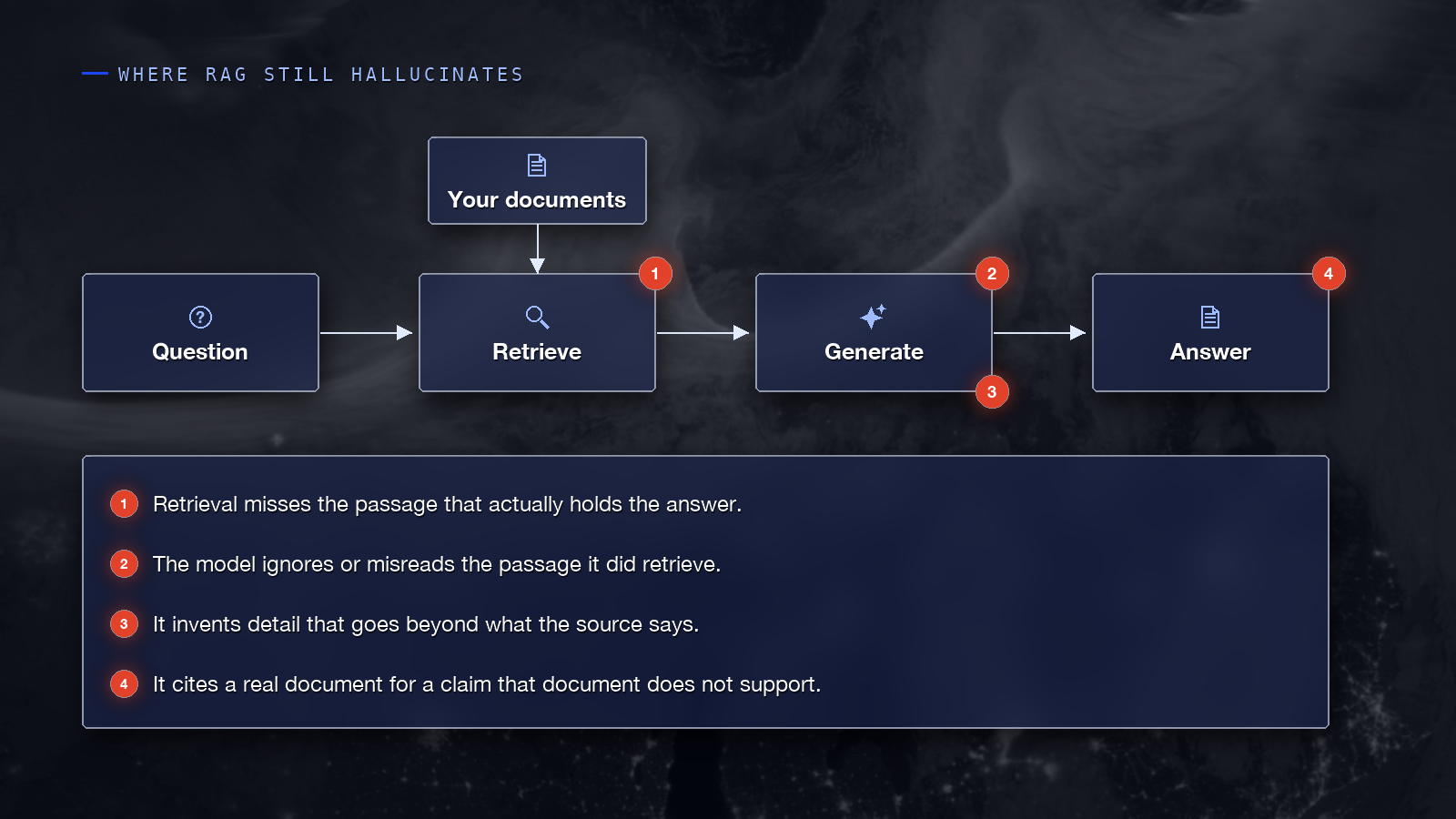
The first is a search problem: if retrieval does not surface the passage that holds the answer, grounding never happens. The other three happen after retrieval, inside the model, which is exactly where RAG has no further say. It can disregard the passage, read more into it than is there, or produce a well-formatted citation to a document that does not actually support the point. All four arrive in the same confident voice a correct answer would.
Why “it cites sources” is not the same as “it is correct”
A citation is reassuring, and that is the danger. A cited document can be entirely real and still fail to support the sentence attached to it. A quote can be stitched from fragments. A list of references can look thorough while one of them was never actually retrieved. The presence of a source is evidence that the system reached for grounding, not proof that the claim is grounded. The only reliable check is to compare each claim against the passage it came from and the record of what the system truly did, rather than against how authoritative the answer reads.
What closes the gap: verification
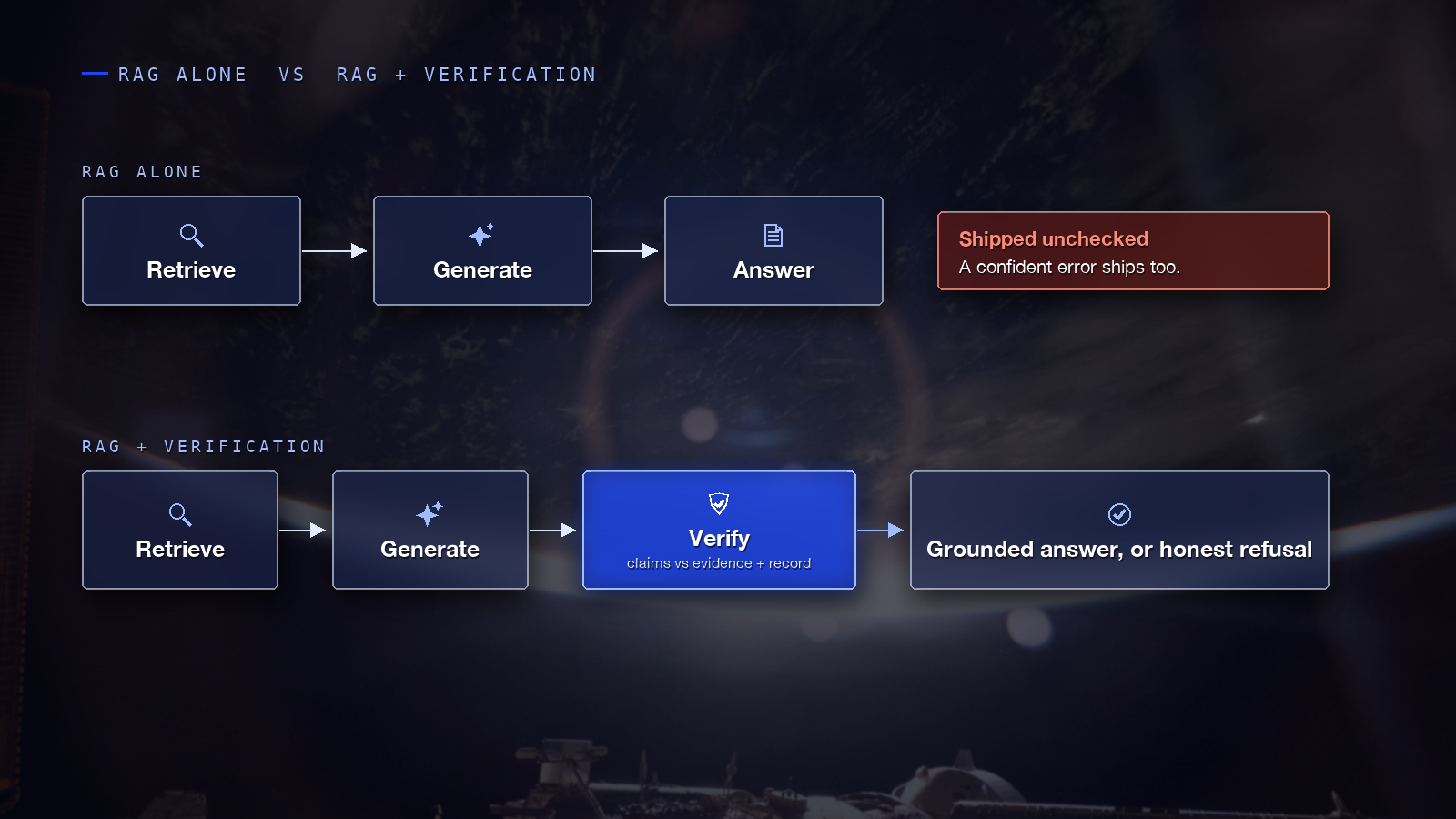
The missing layer is not more retrieval. It is verification after generation. An independent check, separate from the part that wrote the answer, cross-examines each claim against the retrieved evidence and the log of what the system searched or computed. A claim with no matching support is flagged and penalised rather than passed through, and a question that cannot be grounded gets an honest refusal instead of a confident guess.
This is how ThinkerWave approaches it. It keeps a complete record of what it retrieved and computed, and an independent evaluator checks the answer’s claims against that record. A claim with no matching entry is identified as unverified, what our patent calls “phantom verification,” and every quantitative claim is labelled by whether it was retrieved, computed, or estimated. The mechanism, cross-verifying claims against the actual tool record, is the subject of Indian Patent Application #202611044024. The honest headline is the same as everywhere else: it controls hallucination, it does not abolish it, but the errors are caught and shown rather than shipped.
So do I need RAG or verification?
Both, and in that order. RAG is how the system gets the right facts in front of itself; verification is how you find out whether it used them. Retrieval without verification ships confident errors; verification without retrieval has nothing current to check against. The reliable pattern is RAG to ground, then an independent check to confirm, then a refusal when the grounding is not there.
Frequently asked questions
Does RAG eliminate hallucinations?
No. Retrieval-augmented generation reduces hallucination by grounding the model in real documents, which removes a class of pure invention. But it does not eliminate it. The retrieval step can miss the passage that holds the answer, and even with the right passage in front of it the model can ignore it, misread it, over-generate beyond it, or attach a real citation to a claim the source does not actually support. RAG is a strong ingredient, not a guarantee.
Why does RAG still hallucinate?
Four reasons, at different stages. Retrieval can fail to surface the relevant passage. The model can disregard or misinterpret the passage it did get. It can add specifics that go beyond what the source says. And it can cite a document that exists but does not back the sentence it is attached to. The first is a search problem; the last three happen inside the model, after retrieval has done its job.
Is RAG or fine-tuning better for reducing hallucination?
They do different jobs. RAG grounds answers in current, external documents, which is the better lever for factual accuracy and freshness. Fine-tuning changes the model’s behaviour and style but does not give it access to your up-to-date facts, and a fine-tuned model still hallucinates. Neither one verifies its own output. That verification step is the layer most pipelines are missing, whichever of the two you use.
What actually stops hallucination, then?
Verification on top of retrieval: check each claim in the answer against the passage it supposedly came from and against the record of what the system actually did, flag anything unsupported, refuse what cannot be grounded, and keep an auditable trail. That does not make hallucination impossible, nothing does, but it makes the errors catchable and visible instead of shipped. The honest framing is controlled, not zero.
Related: how to verify AI output · deterministic AI vs verifiable AI · is zero-hallucination AI real?.
ThinkerWave is an autonomous, self-correcting reasoning engine for complex, high-stakes problems. Its claim-verification mechanism is the subject of Indian Patent Application #202611044024, and it runs on your own machine against your own model credentials.
Try it on your own problem
ThinkerWave works a hard problem from several angles, checks its claims against the evidence, and keeps a full record of how it got there. It runs on your machine, with your own model keys.